November 25, 2021
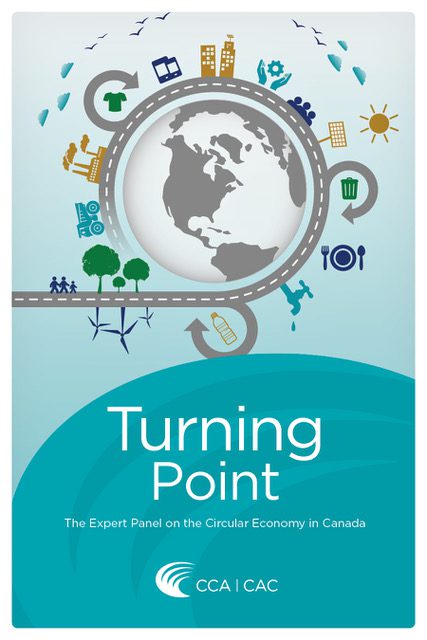
Turning Point
The Expert Panel on the Circular Economy in Canada
Humanity’s current level of consumption is exceeding Earth’s ability to sustain it. In the current “take-make-use-waste” linear economy, raw materials are extracted to produce goods that are used and then discarded as waste. Though much of what we discard still holds value, just a small portion of materials is cycled back into the economy. The vast majority ends up in landfills, incinerated, or is released into the environment. While non-renewable resources are being depleted and renewable resources are being extracted faster than they can be replaced, demand for products and materials continues to rise.
The impacts of these consumption habits include land degradation, pollution, biodiversity loss, and the emission of greenhouse gases, as well as economic and social impacts, including the disproportionate exposure of marginalized communities to pollution.
Increasingly, the circular economy (CE) is being considered as an alternative to the dominant linear economic model. The CE conserves material resources, reduces energy and water use, and generates less waste and pollution, ultimately reducing the impacts of extracting resources while still meeting the material needs of a growing global population.
Environment and Climate Change Canada asked the CCA to examine the potential economic, environmental, and social impacts of advancing a circular economy in Canada.
Turning Point explores what a circular economy is, how it works, and what it could mean for Canada. It examines the opportunities and challenges Canada will face in planning a circular economy transition. Included in the report is an estimate of the current circularity of the Canadian economy and four scenarios that illustrate what the Canadian economy could look like in 2040 (the interactive SankeySim model for Canada that was developed by the Panel can be accessed here).
The Sponsor:
Environment and Climate Change Canada
The Question:
What are the potential opportunities and challenges for a circular economy in Canada?
The Expert Panel on the Circular Economy in Canada